
Loading...
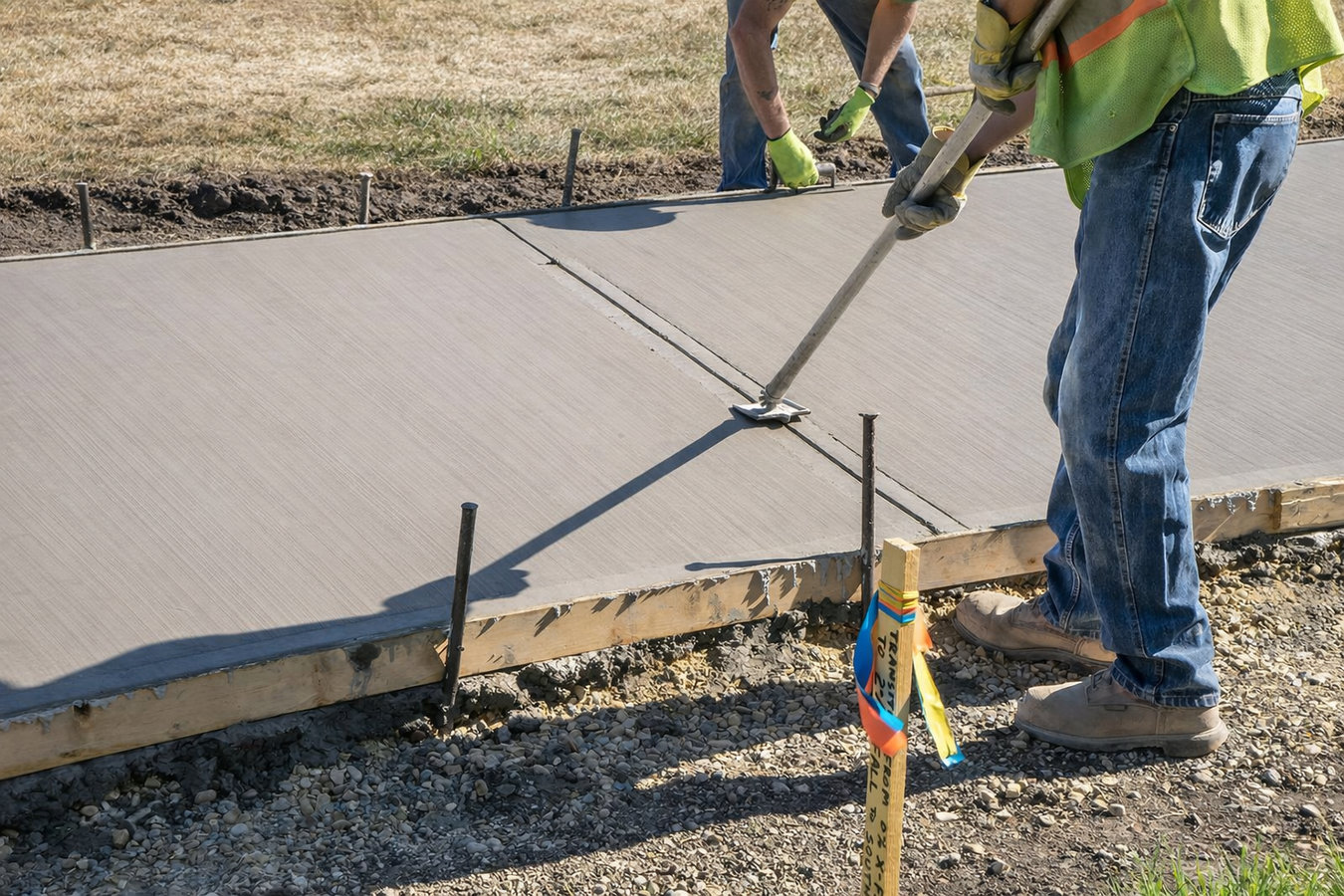
A cracked or uneven sidewalk is a trip hazard and a liability. We build concrete walkways that drain correctly, pass borough inspection, and hold up through decades of Pennsylvania winters.
Concrete sidewalk building in State College means removing the old surface, digging to the right depth, compacting a crushed-stone base, and pouring a properly finished slab - most residential walkways take one to two days of active work, with the surface walkable again within 24 to 48 hours.
Homeowners in State College deal with sidewalks that have been lifted by tree roots, chipped apart by years of road salt, or simply never built to handle the freeze-thaw cycle that hits central Pennsylvania every winter. When the damage is widespread, repeated patching adds up fast and does not solve the underlying base problem. A new walk built with the right base depth, the right concrete mix, and proper control joints will outlast a patched-up surface by a decade or more.
If your property also needs a new driveway, combining both projects under one contract saves time and mobilization cost. Our concrete driveway building service handles the full exterior - same crew, same quality standards, one job.
If one section of your sidewalk has risen higher than the next - even by half an inch - it is a trip hazard. This is especially common in State College's older neighborhoods where tree roots have been growing under concrete for decades. You can feel it when you walk across it, and you can see the lip between slabs when you look down the length of the walk.
If the top layer of your concrete looks like it is peeling away in thin chips or has developed a rough, cratered texture, that is spalling. In State College, this is almost always caused by years of freeze-thaw cycles combined with road salt exposure. Once spalling starts, it tends to get worse each winter - a walk that is spalling badly is past the point of patching.
Water should always flow away from your foundation. If you notice puddles forming against your house after rain, or if your walk seems to slope toward the building, the original installation may have been done incorrectly - or the ground has settled. A new sidewalk installed with the correct slope solves both the drainage and the foundation moisture problem at once.
The Borough of State College actively enforces sidewalk maintenance standards, particularly in areas with high pedestrian traffic. If you have received a notice from the borough about your sidewalk being a hazard or out of compliance, you are on a timeline to fix it. Ignoring these notices can result in the borough making the repairs and billing you - typically at a higher cost than hiring your own contractor.
Every concrete sidewalk building project starts with a site assessment - we look at the existing surface condition, measure the area, check for tree root involvement, and evaluate drainage before we quote. Demo and haul-away of the old concrete is included in our pricing so there are no surprise line items when the invoice arrives. We dig to proper depth, lay and compact a gravel base layer, set forms, and pour concrete at the right thickness for the intended use - four inches for standard foot traffic, thicker where the walk crosses a driveway or handles heavier loads. Control joints are cut at the right intervals so any future cracking stays in planned, nearly invisible lines. A broom finish gives the surface the grip it needs in rain and ice - the right texture for State College winters, not too smooth and not too rough to shovel. If you want a more decorative look, we can also connect your walk to a garage floor concrete project or match it to stamped surfaces elsewhere on the property.
We handle the permit application with the Borough of State College or your township as a standard part of every job. Permitted work means an inspector signs off, which protects you if you ever need to document the work for a sale or an insurance claim. If tree roots are involved, we discuss your options honestly before work starts - not halfway through the job.
The most common project - a clean concrete path from your driveway or street to your front door, properly sloped and finished.
For homeowners who have received a violation notice - we move quickly, pull the permit, and get the inspection handled.
Where a walkway crosses a driveway, we pour at the right increased thickness to handle vehicle weight without cracking.
A slightly textured finish that gives solid grip in rain and ice - practical for State College winters, easy to shovel.
For properties with mature trees - we assess root conditions before quoting and discuss barrier or rerouting options.
Stamped patterns or colored finishes available for homeowners who want a walkway that matches a decorative patio or driveway.
State College's freeze-thaw climate is one of the harshest environments for concrete in the mid-Atlantic region. Temperatures regularly swing above and below freezing from late October through March, and the road salt that Centre County puts down to keep streets and sidewalks safe migrates onto residential surfaces over time. Salt attacks the surface of concrete, causing the flaking and pitting known as spalling - a problem that compounds with every winter cycle. We use air-entrained concrete mixes specifically formulated for freeze-thaw resistance, and we do not rush the cure before sealing. The Portland Cement Association documents why mix design and curing conditions matter so much in cold-weather markets - the approach we follow on every job.
Many of State College's older residential streets - particularly in neighborhoods near Penn State's campus - have large, mature trees whose roots have been growing under sidewalks for decades. Replacing a sidewalk without addressing the root situation often means the same problem returns within a few years. Homeowners in Bellefonte and Lock Haven face the same combination of cold winters, older housing stock, and tree-lined streets - conditions we know well and plan for on every project.
We come to your property, walk the area, measure, and assess root conditions and drainage. You get a written estimate within 1 business day of your inquiry - demo, base prep, pour, permits, and cleanup all itemized.
We handle the permit application with the Borough of State College or your township. Permit approval typically takes a few days to two weeks. We schedule your start date once the permit is in hand - no surprises.
The crew removes old concrete, hauls it away, digs to depth, compacts the gravel base, sets forms, and pours. Most residential walks are finished in a single day. The crew marks utilities through PA One Call before any digging.
You can walk on the new surface within 24 to 48 hours. Keep vehicles off it for at least a week. Before we leave, we walk the finished project with you, confirm the slope, and explain when to apply a sealer and what to avoid in winter.
Free on-site estimate, written quote with no surprises. We respond within 1 business day.
(814) 996-0735We pull the required permit from the Borough of State College or your township on every sidewalk project - no exceptions. Permitted work gets inspected, and that inspection is documentation that your walk meets local standards. That matters if you sell your home or need to respond to a borough notice.
State College's older neighborhoods have beautiful mature trees that also happen to lift and crack sidewalks. We assess root conditions as part of every site visit and discuss your options honestly - root barriers, path adjustments, or borough coordination - before work starts. Replacing a walk without addressing roots is a temporary fix we refuse to sell.
We use air-entrained concrete mixes designed for Pennsylvania's freeze-thaw climate. Air entrainment creates microscopic bubbles in the concrete that give expanding ice water somewhere to go - reducing the internal pressure that causes spalling. This is not the same mix used in warmer states, and it matters in Centre County.
Every sidewalk we build is graded to move water away from your foundation. Improper slope is one of the most common and most overlooked sidewalk problems in this area. Getting it right on a new pour costs nothing extra - correcting it after the fact means breaking out the slab and starting over. We verify the grade before the forms come off.
A sidewalk built correctly for this climate - the right mix, the right base, the right slope, and a permit on file - will outlast a cheaper job by years. We have done this work in State College long enough to know what the borough expects, what the soil does, and what a central Pennsylvania winter takes out of a concrete surface that was not built for it.
Extend your exterior concrete work to the garage floor - same durable finish, built for vehicle traffic and winter conditions.
Learn MorePair a new walkway with a full concrete driveway replacement for a complete, matched exterior upgrade.
Learn MorePermit season fills up fast - reach out now and we will lock in your project date before the summer rush.